For several years, businesses were hiring companies for offshore development due to a very simple reason that they could do the same work but at a much lower cost. This trend has continued into recent years but now that is not what is interesting anymore.
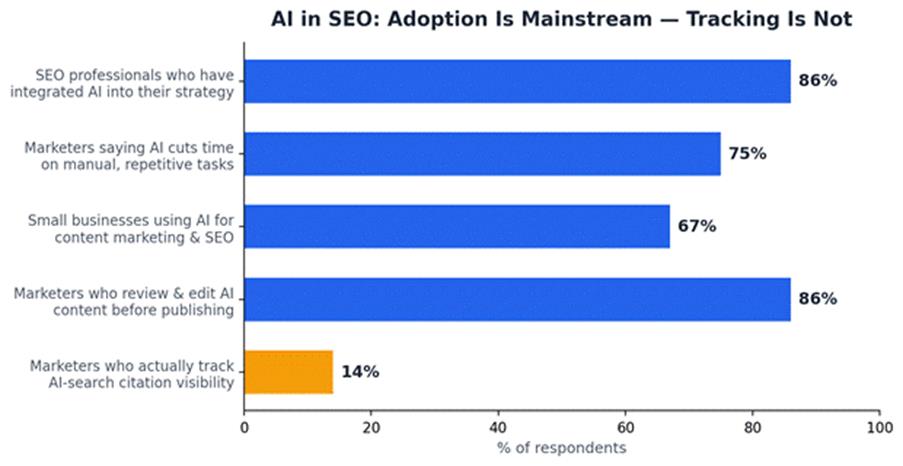
The most interesting part is what AI has done to the whole story. According to Aira’s State of SEO Report, about 86% of SEO specialists have already used AI in their strategies, and the AI SEO tools market will grow from $1.2 billion in 2024 to $4.5 billion in 2033.
The teams doing offshore development who are currently experiencing a period of high pressure from coding, costs, content, etc. began to utilize AI tools faster than anyone else on the planet. The outcome is a new type of product, SEO services of the same high quality but with low prices.
AI Use by Offshore Teams
It is explained below as a five step process:
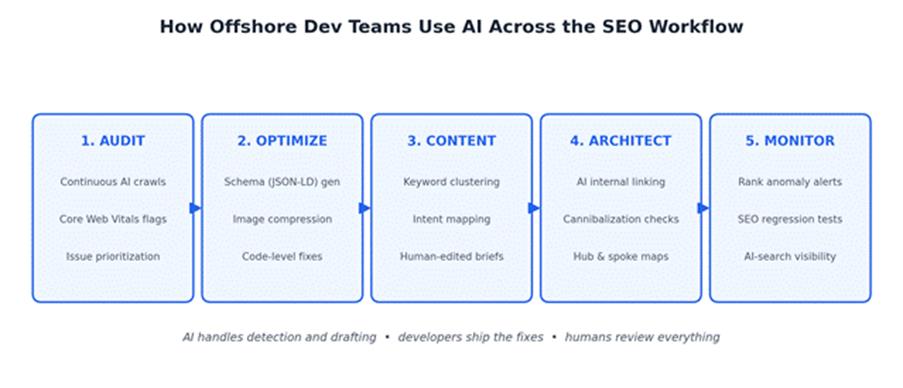
The five-stage AI-assisted SEO workflow used by modern offshore development teams.
1. Technical SEO Audits That Never Stop Running
In the past, SEO audit was conducted once a quarter when a consultant would crawl your website and provide you with a report in form of a 60-page PDF document while half of the recommendations would end up stuck somewhere in the backlog.
Machine-learning crawlers monitor the site around the clock, flagging Core Web Vitals regressions, broken internal links, orphan pages, render-blocking scripts, and indexation problems the moment they appear, not three months later.
The AI carries out detection, but the ruling part falls to the team. An automated website scan can find hundreds of issues but resolving them in the same order will make the entire effort a waste of resources.
The greatest advantage of a good offshore team is its ability to prioritize and, for example, resolve a template-level no-index issue today while deferring cosmetic alt-text fixing for another time.
There is a reason why out of 75% marketers that use AI in their work, 75% claim it helps them reduce the time spent on repetitive activities (HubSpot’s State of Marketing report): auditing is a good case in point. What could take a manual week of audits is now done in several hours.
2. Code-Level Optimization at a Scale
A structural advantage held by development companies over pure SEO agencies is their ability to reach the codebase directly without the need of filing tickets and waiting.
AI speeds up each step of the process: the use of language models allows developers to generate JSON-LD schema markup for certain types of pages.
3. Content and Keyword Intelligence With a Human Editorial Layer
Previously, keyword research was associated with exporting spreadsheets and examining search volumes visually.
However, nowadays, offshore teams make use of technology utilized to execute AI clustering, which is the method of grouping thousands of keywords using the intent and mapping against current pages, thus defining gaps where competitors are highly ranked.
Based on clusters, the system generates content briefs with the help of AI; a large share of marketers utilizes AI technology for making their job easier.
Here’s the part serious teams get right and cheap ones skip: the human layer is non-negotiable. Fully 86% of marketers say they review and edit AI-generated content before publishing, and the offshore teams worth hiring build that editorial review directly into the pipeline.
AI produces the scaffolding; a subject-aware human produces the judgment, the specificity, and the voice. Content that skips this step reads generic, earns no links, and increasingly gets filtered out by both search engines and readers.
4. Internal Linking and Site Architecture, Mapped by Machines
Past a few hundred pages, internal linking stops being something humans can manage by memory. Offshore teams working on programmatic sites and large e-commerce catalogs, their bread and butter now use AI models that understand semantic relationships between pages.
The models suggest contextually relevant internal links, detect keyword cannibalization where two pages compete for the same query, and inform hub-and-spoke architectures that concentrate topical authority instead of scattering it.
The benefits multiply, since the mixture of the right internal linking enhances crawl budget usage, brings existing deep pages into light again and provides search engines with a better map of what the website is about.
Also read: How Cloud Applications Support Business Growth
5. Monitoring, QA, and the New AI-Search Frontier
The silent killer of SEO performance has always been the deployment that breaks something invisible, a template change that no indexes a category, a redirect chain introduced by a migration, a JavaScript update that hides content from crawlers.
On top of that, AI-driven anomaly detection watches rankings and traffic patterns, alerting the team to unusual drops within hours instead of at the end-of-month report.
A major trend is shaping the industry. The notion of search is shifting: AI summaries are now ranking among many Google queries and more than 58% of searches result in zero clicks.
Smart teams have widened the scope of their deliverables to include AI-search optimization. Hence, they are focusing on structuring information in such a way that it gets cited by AI summaries, ChatGPT, and Perplexity instead of just ranking as a blue link.
The opportunity is large: while 43% of marketing experts classify AI optimization as a key priority, only 14% monitor their AI quoting. Businesses which measure this are opening a niche that very few have ventured into yet.
What to Ask Before You Hire an Offshore Partner
Answering these questions can help differentiate the real experts from self-proclaimed industry players:
• Which AI tools are in your stack and what does a human verify? If everything is automated, nothing is trustworthy.
• Do you run SEO regression tests before deployments? This one question filters out most of the market.
• Do you track AI-search visibility, or only rankings? Rankings alone are yesterday’s scoreboard.
The Final Conclusion
AI did not put an end to the work of offshore teams; instead, it amplified their efficiency. The cost advantage helped them get a foot in the door.
However, AI-enhanced operations, continuous auditing, code correction, intelligent content creation, architecture mapping, and ongoing monitoring are what increasingly encourage businesses to hire offshore developers to access skilled software expertise and achieve better project outcomes.
Author Biography:-

Harikrishna Kundariya, is a marketer, developer, IoT, Cloud & AWS savvy, co-founder, and Director of eSparkBiz, a Software Development Company.
His 15+ years of experience enables him to provide digital solutions to new start-ups based on IoT and SaaS applications.