| “Unreliable data about who to target at accounts is the top challenge for ABM marketers.” — Tim Bollish, Market Research Manager, LinkedIn |
The challenge sits at the core of account-based marketing. ABM performance often breaks down before outreach begins, when target account selection is built on incomplete, outdated, or weakly qualified data. The result is misallocated spend, wasted sales effort, and weaker relevance across the program.
This is why data enrichment has become essential to ABM execution. By appending firmographic, technographic, and intent-rich signals to raw B2B records helps businesses sharpen ICP definition, map buying committees, personalize engagement, and prioritize accounts based on fit and buying interest.
This blog examines how poor targeting affects ABM performance, how data enrichment strengthens account-based marketing, and how B2B data enrichment services help.
The Impact of Ineffective Targeting in Account-Based Marketing
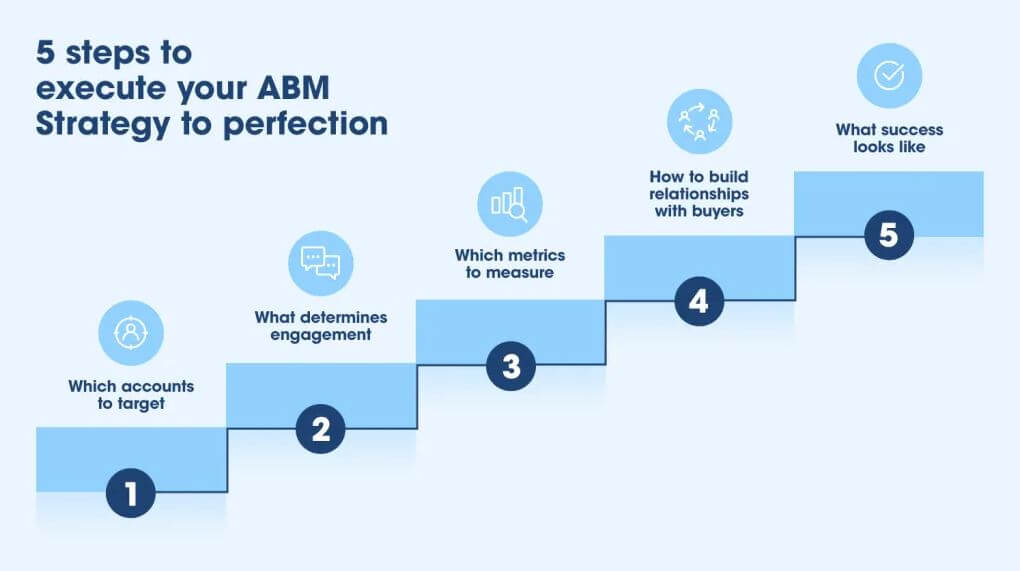
[Source: Salesforce| Account-Based Marketing Guide]
According to Salesforce, the first step to execute an ABM strategy is to identify which accounts to target. For businesses, the consequences of ineffective targeting compound across various operational layers. Here’s how;
– Wasted Budget: Broad targeting or targeting the wrong accounts leads to high ad spend. Since there is no intent in these misidentified accounts, premium budgets are exhausted on audiences with no buying authority, directly inflating the Cost Per Acquisition (CPA) and lowering the Return on Ad Spend (ROAS).
– Misallocation of Resources: In the case of broad or inaccurate account targeting, sales and marketing teams waste their time and efforts on low-fit leads. This often leads to longer sales cycles and lower pipeline efficiency.
– Damage to Brand Reputation: Account-based marketing is built around relevance. When targeting is inaccurate or broad, the outreach is perceived as ‘noise’ by the stakeholders. This positions the brand as intrusive rather than an informed strategic partner, making future outreach less effective.
Also read: A Practical Guide to Custom Telemedicine Software Development in 2026
How Data Enrichment Strengthens Account Targeting:
Raw B2B data often contains sparse, incomplete, and sometimes outdated account information. It, therefore, lacks the context and depth needed to accurately assess an account’s purchase propensity. Data enrichment transforms static records into actionable intelligence by appending firmographic, technographic, and intent-rich information to account data.
The Strategic Role of Data Enrichment in Account-Based Marketing (ABM)
I. Defining the Ideal Customer Profile (ICP)
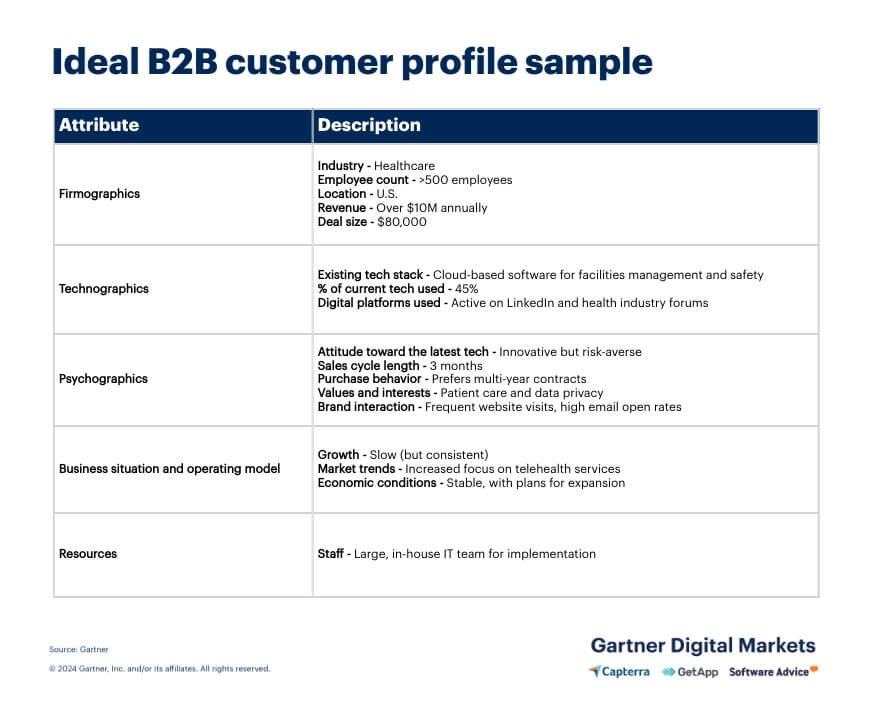
An ideal customer profile determines how accurately the target account list (TAL) aligns with the conversion potential. Data enrichment adds the account-level signals used to validate that fit, such as;
Firmographic Attributes
- Company Revenue: Revenue range estimates that help assess commercial fit.
- Organizational Structure: Identifying parent companies, subsidiaries, and headquarters to assess account hierarchy, scale, and buying complexity.
- Geographic Presence: Identifying the regions in which the business operates to assess territory fit and market relevance.
Technographic Profiling
- Current Vendors: Identifying which competing or complementary tools are already in place.
- Technology Stack: Understanding the core systems, platforms, and infrastructure already in place within the organization.
- Technology Adoption Signals: Indications that the account may be evaluating, replacing, or expanding tools in relevant categories.
Strategic Triggers
- Funding Events: Recent investment can signal upcoming expansion in operations, hiring, or technology.
- Mergers and Acquisitions: Indicates integration needs across systems, workflows, and business structure.
- Executive Leadership Changes: Marks a shift in business priorities, budgets, and technology direction.
II. Mapping the Buying Committee
According to Forrester’s The State of Business Buying Report, on average, B2B buying decisions involve 13 stakeholders, and 89% of purchases require participation from two or more departments. Data enrichment helps map the account by identifying the individuals who influence the buying process and hold decision-making authority across the committee.
Identifying Key Personas
- Job Functions and Sub-functions: Distinguishing between roles such as a VP of IT and a VP of IT Infrastructure.
- Seniority Levels: Identifying whether the stakeholder is involved in evaluation, budget ownership, or final decision-making.
- Professional Background: Understanding prior roles, companies, or technology exposure to improve message relevance and contextual alignment.
III. Enabling Personalization at Scale
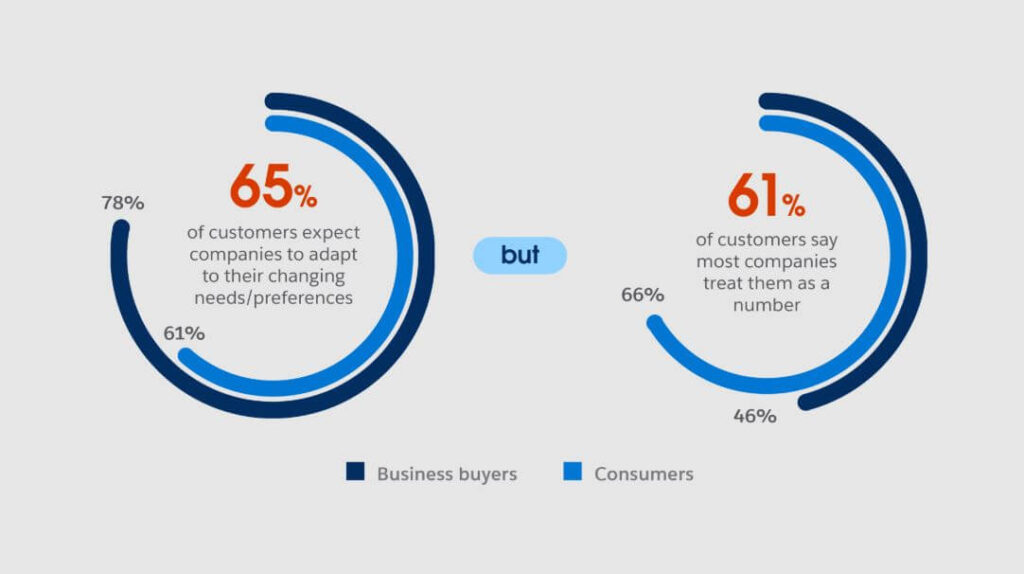
A clear gap persists between what business buyers expect from personalized engagement and what most companies actually deliver. In account-based marketing, closing that gap depends on turning account intelligence into context-aware messaging at scale. Data enrichment delivers clear value by adding the firmographic, technographic, and behavioral context needed to create targeted campaigns and account-specific messaging rather than relying on broad audience segments.
1. Tailored Messaging by Pain Point
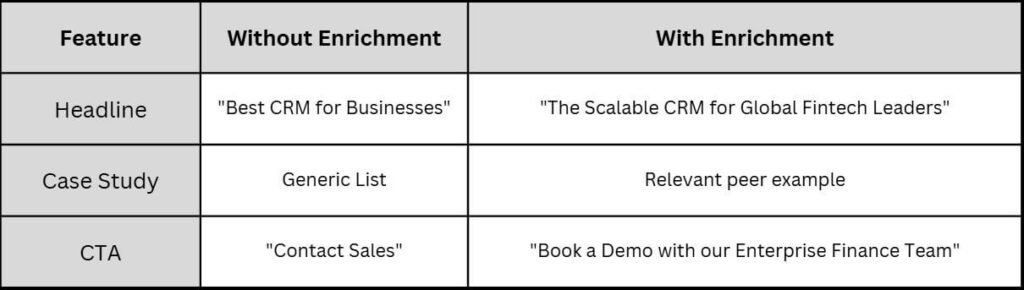
Data enrichment improves message relevance by revealing the account’s existing technology stack, likely constraints, and solution gaps. For instance, if a target account is using a competitor’s product known for limited scalability, messaging can be positioned around scalability, ease of migration, or operational flexibility.
2. Industry-Specific Social Proof
Enrichment allows teams to serve case studies, proof points, and content relevant to the account’s industry and size. For instance, an enterprise financial services firm is more likely to respond to peer-level case studies than to messaging designed for early-stage companies.
3. Dynamic Website Experiences
Using IP-to-company identification, websites can be tailored for visitors from target accounts by adjusting headlines, calls to action, and supporting content based on known account attributes.
IV. Predictive Account Scoring and Prioritization
A target account list (TAL) includes accounts at different stages of buying readiness. Data enrichment improves account prioritization by helping teams evaluate both fit and current buying interest. It enriches the CRM data with firmographic, technographic, and intent data for predictive modeling.
- First-Party Intent: Activity on owned properties such as white paper downloads, pricing page visits, or repeat website engagement.
- Third-Party Intent: External research signals from publisher and review networks that indicate category-level interest.
V. Operational Excellence and Data Hygiene
The effectiveness of any MarTech stack—CRM, marketing automation, and sales engagement—is limited by the quality of the underlying data. B2B data evolves continuously as contacts move into new roles, companies rebrand, or business structures change. Marketing data enrichment helps maintain CRM records by improving record completeness, accuracy, and freshness. This reduces:
- Bounced Emails
- Sales outreach to outdated contacts
- Wasted ad spend on irrelevant audience segments
VI. Sales and Marketing Alignment for ABM
Effective account-based marketing depends on alignment between sales and marketing around target account selection, prioritization, and engagement strategy. When both teams operate from different account criteria or qualification signals, targeting precision weakens, and execution becomes fragmented. Data enrichment for sales and marketing supports tighter alignment by giving both teams a shared account view grounded in fit, structure, and buying signals.
- Shared ICP Criteria: Both teams evaluate accounts against the same qualification framework and target account criteria.
- Prioritization Visibility: Sales can see why specific accounts have been prioritized based on firmographic fit, technographic context, and intent signals.
- Closed-Loop Refinement: Sales activity can validate, refine, or challenge enriched account data, improving future account selection and prioritization.
The Business Imperative: For many B2B organizations, in-house teams operate under limited capacity, high resource costs, and the technical complexity of integrating disparate data sources, which makes it difficult to keep account data complete, accurate, and current. These constraints are further compounded by the need to manage ongoing updates while maintaining compliance with privacy regulations such as GDPR and CCPA. B2B data enrichment services address these gaps by providing access to verified third-party datasets, infrastructure, specialized expertise, and scalable resources that are too costly and time-intensive to replicate internally. This enables businesses to focus internal teams on account strategy, campaign execution, and pipeline growth.
Author Bio:

Brown Walsh is a content analyst, currently associated with SunTec India– a leading multi-process IT outsourcing company. Over a ten-year-long career, Walsh has contributed to the success of startups, SMEs, and enterprises by creating informative and rich content around topics, like data annotation, image annotation and video annotation services. Walsh also likes keeping up with the latest advancements and market trends and sharing the same with his readers.